
Gallery Sensory Guides
.png)
Ancient Meso-America
Mesoamerica is that area defined by related contiguous cultures from the arid areas of northern Mexico to the tropical areas of Guatemala and Honduras in the south. The area encompasses great ecological, linguistic and cultural diversity.
Cenozoic Lobby
As you enter the museum through the Cenozoic Lobby, animals dating from the Pliocene-Pleistocene Epochs, approximately 3 million years to 10,000 years ago, greet you. These include mammoth, mastodon, American lion, one-toed horse, the armadillo-like Glyptotherium, and four species of fossil turtles.


Cretaceous Seas
100 million years ago a warm seaway teeming with marine life separated eastern and western North America. Some terrestrial reptiles returned to the sea in the earlier Triassic Period (252–201 million years ago), some much later. The three marine reptiles shown here, mosasaur, pliosaur and sea turtle, represent three separate re-invasions of the sea.
Cultures of the Ancient Americas
Sometime around 15,000 years ago, the glacial ice sheets that covered northern North America for thousands of years began to retreat. This allowed people living on the other side of the ice in Beringia, the region between the continental areas now known as Alaska and Siberia, to enter North America.


Dinosaur Hall
Dinosaur Hall is filled with examples of these magnificent creatures from throughout their history.
Exploration Station
The Exploration Station is a WOW place for fun and creativity for all ages. Learn more about Arizona Museum of Natural History exhibitions through hands-on activities!


History Courtyard/Gold Panning
In the outdoor History Courtyard, explore Arizona’s historic 5 C’s: Cotton, Cattle, Citrus, Copper and Climate. The 5 C’s supplied the economic foundation for early Arizona. Pan for gold, free with museum admission!
Lost Dutchman's Mine
Explore twists and turns of the legendary Lost Dutchman Mine, see the shadowy figure of the Lost Dutchman at work, and examine miners’ artifacts and equipment.


Lower Ramp
The emergence of vertebrates onto land, and the transition from fish to amphibian is well known. Less appreciated is the emergence onto land of plants and at least eleven other animal groups.
Meteorite Gallery
See and touch several meteorites, including a replica of the Tucson Meteorite and a piece of the Canyon Diablo Meteorite, which created Meteor Crater when it struck the earth in what is now Arizona.


Mineral Hall
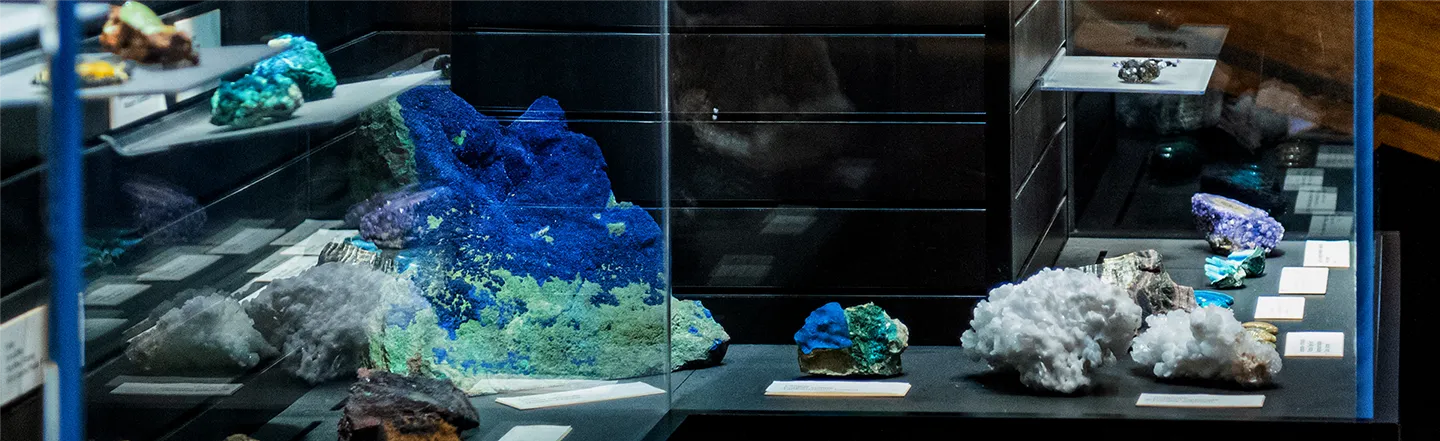
Learn how the three types of rocks, sedimentary, igneous and metamorphic, are formed. Discover the essential minerals and see blue and green copper minerals and red and orange lead minerals. Touch a drusy chrysocolla boulder and quartz crystals! Learn all about caves.
Native Cultures of Western North America
Native Cultures of Western North America explores the lifeways of dozens of Native American peoples from the Mississippi River to the Pacific Ocean, from Alaska to Mexico. Their stories are told through objects of material culture and works of art.


Never Sweat Tunnel
Visit the Never Sweat Mine. See mining cars and equipment, and learn about one of Arizona's major industries.
ORIGINS
In the Origins gallery, voyage through the timeline of the cosmos and discover major events in the history of planet Earth.


Paleo Dig Pit
Get set to dig for fossils! Explore worlds of the past by digging for dinosaur fossils, eggs, and more.
Southwest Cultures
The arid deserts and high plateaus of the American Southwest gave rise to three unique prehistoric cultures, Ancestral Pueblo (Anasazi), Mogollon and Hohokam. All dates are BCE (Before Current Era, or BC) and CE (Current Era, or AD).


Spanish Arizona
Spanish conquistadors and priests first came to what is today Arizona with Coronado in 1541. Spaniards established a presence in southern Arizona beginning in the late 1600s to spread the Catholic faith, to search for mineral wealth and to claim the land for Spain. Spanish explorers established missions along rivers and trade routes in southern Arizona and among Native American communities. Visit the recreated early 18th century Spanish Guevavi mission.
Territorial Jail Cells
For those who broke the law in Arizona, there were Territorial Jails. In these real jail cells, see how outlaws, cattle rustlers other criminals served their time!


Venomous Animals of the Sonoran Desert
Explore and learn about venomous animals in the Sonoran desert such as snakes and other reptiles!